
Interior designer in France: studies, schools and careers
The French route to becoming an interior designer: the DN MADE and DSAA path, the unprotected title, CFAI recognition, careers, pay and how the skill travels.
Editorial team · Published on 23 July 2026
11 min read
Contents
- The interior designer profession at a glance
- Daily life: duties and settings
- A typical day (a made-up example)
- Studying to become an interior designer: from the baccalaureate to the diploma
- Careers, entry and pay
- Who the job suits: qualities and interests
- Bridges and changing course
- An international perspective
- Key takeaways
- Going further
Interior design draws many secondary-school students who are sensitive to design, decoration and the shaping of spaces. It is a creative and concrete job, where an existing place is turned into a space that is better thought through, more functional and more pleasant to be in. It is also a job whose route in is markedly blurrier than that of other professions, and that deserves to be set out plainly from the start.
This profile describes the French route, and two common misconceptions need correcting straight away. First, an interior designer (in French an architecte d’intérieur) is not an architect in the sense of the professional register: the two jobs are distinct and do not follow the same rules. Second, the interior designer title is not protected in France, which means no diploma is legally required to practise. That is not disguised good news: it shifts the whole of the selection onto the quality of the training and onto what the market genuinely recognises.
The sections below explain the reality of the route in, the qualifications that carry weight, the point to watch on schools, the day-to-day of the job, pay with its zones of uncertainty, and the kind of profile it suits. A closing section looks at how the French route and the skill itself travel for international and expatriate families. Without overselling.
The interior designer profession at a glance
An interior designer conceives, reorganises and shapes interior spaces: homes, shops, restaurants, offices, hotels. They work on volumes, light, circulation, materials, furniture and colour, to make a place both functional and consistent with the client’s use and budget. They act on the existing fabric without, in principle, touching the load-bearing structure or the building envelope, a scope that belongs to the architect.
The central legal point: the profession is not regulated and the title is not protected. Unlike the architect entered on the register (the Ordre des architectes), whose title is framed by law, anyone may call themselves an interior designer. There is, however, a voluntary recognition, the “architecte d’intérieur CFAI” title, granted by the Conseil Français des Architectes d’Intérieur (the French council of interior designers) to professionals it judges competent against its criteria. It is a mark of seriousness, not a legal obligation.
The sector: interior-design and design studios, fit-out practices, self-employed work, and sometimes large accounts (retail, hospitality). Status varies: employed in a studio, or self-employed. Under France’s national job classification run by France Travail, the job falls under ROME code F1102, “design and fitting out of interior spaces”.
Daily life: duties and settings
The day-to-day blends creativity, technical work and client relationships. A few duties come up often:
- Listen to the client’s need, analyse the space, set a budget and a brief.
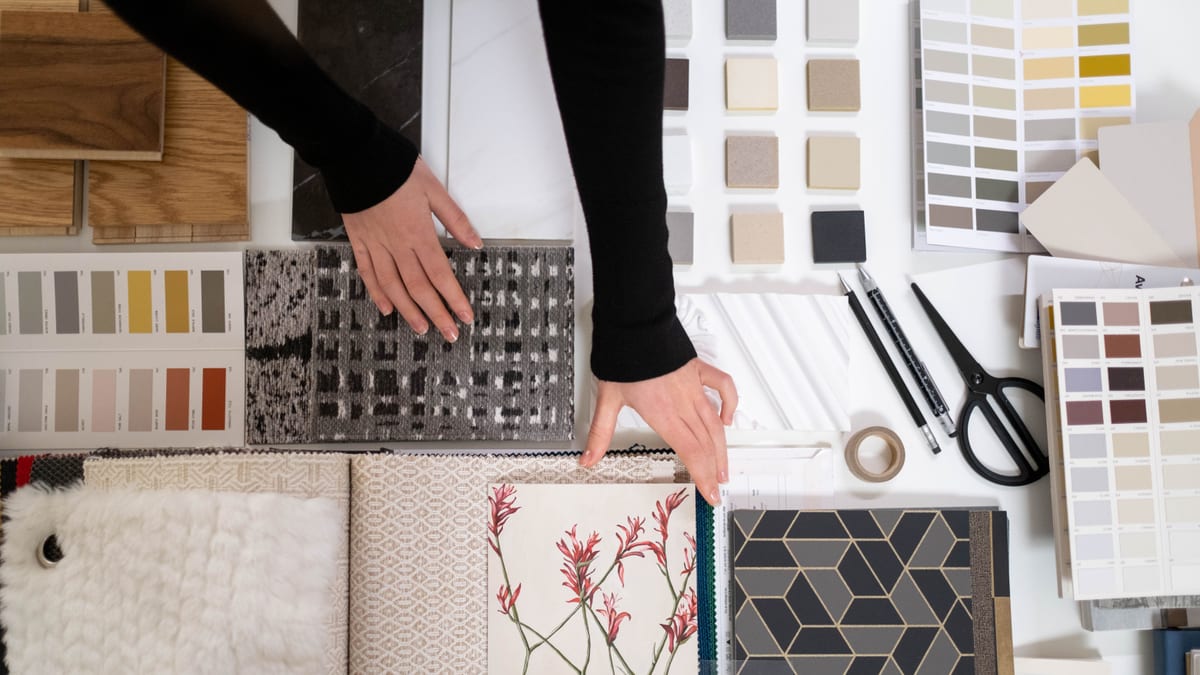
- Design the project: plans, sketches, 3D images, material and mood boards.
- Choose the materials, finishes, lighting, furniture and colours.
- Cost the work, consult tradespeople and suppliers, compare quotes.
- Follow the site, coordinate the trades, check compliance and deadlines.
- Manage the client relationship over time, including surprises and budget trade-offs.
The setting depends on status. In a studio, you work in a team, often on several projects at once, with design software (drawing, 3D modelling) and frequent back-and-forth between the studio and the sites. As a freelancer, you combine the creative work with prospecting, admin, invoicing and sales follow-up: the entrepreneurial side takes up a lot of room, especially at the start.
A typical day (a made-up example)
Take a fictional example. Julien, an interior designer employed at a small studio, starts the morning with a site visit to check progress on a flat renovation and clear a sticking point with the joiner. Back at the studio, he finalises plans and a 3D image for a shop, then calls a supplier to lock in a tile delivery date. In the afternoon, a client meeting to present two layout options and settle a tight budget. He ends by costing a new project. A varied rhythm, plenty of coordination, and the concrete satisfaction of watching a space take shape.
Studying to become an interior designer: from the baccalaureate to the diploma
Because the title is not protected, there is no single compulsory diploma. There are, on the other hand, recognised routes, and that is where future credibility is decided.
The main public route runs through the applied-arts and design schools. After the baccalaureate, you apply for the DN MADE space specialism (Diplôme national des métiers d’art et du design, the national diploma in art and design trades), a three-year course carrying bachelor’s-degree status (bac+3). It is very often extended by a DSAA design space specialism (Diplôme supérieur d’arts appliqués, the higher diploma in applied arts), a two-year course at bac+5 level. This pairing, DN MADE then DSAA, is the clearest public pathway into the job.
There are also private schools of interior design. Some are solid and recognised by the CFAI, others far less so. This is the single biggest thing to check: before committing, especially where annual fees are high, verify that the diploma is registered on the RNCP (the national register of professional certifications), whether the CFAI recognises it, the real graduate outcomes and the quality of placements. An impressive-sounding course name guarantees nothing.
On the school-leaving profile: no subject speciality is compulsory, but a coherent file often combines visual arts, ease with mathematics (scale, volumes) and good general culture. Many schools recruit on a portfolio (book) and interview, sometimes through Parcoursup (France’s national admissions platform) for the public route. The ability to draw and to defend a project weighs heavily.
| Stage | Duration | Diploma / step |
|---|---|---|
| Final school year + application (Parcoursup or school entrance) | 1 year | Portfolio, interview, application file |
| DN MADE space specialism | 3 years | Bachelor’s-degree status (bac+3) |
| DSAA design space specialism (recommended) | 2 years | Bac+5 |
| CFAI recognition (optional) | After experience | ”Architecte d’intérieur CFAI” title |
Careers, entry and pay
We have to be honest: this is not a shortage occupation. The market is competitive and sensitive to the economic cycle of building, renovation and decoration. When the sector slows, projects thin out. Entry depends heavily on the portfolio, the placements done, the network built and the intended status. Freelance beginnings are often slow to become profitable, while a client base and a reputation are built.
On pay, the figures are variable and to be treated with caution. In a studio, a beginner starts from around 2,300 euros gross per month early on (ONISEP, 2026), the range rising towards 3,000 to 4,500 euros gross for experienced profiles depending on region, the size of the practice and the segment (luxury and Paris pulling salaries up). As a freelancer, income depends entirely on activity, reputation and the ability to win projects: it can be higher, but with a real element of uncertainty, especially in the first years.
| Situation | Indicative pay (gross monthly, 2026) |
|---|---|
| Beginner in a studio | from around 2,300 euros (ONISEP) |
| Experienced in a studio | around 3,000 to 4,500 euros |
| Established freelancer | highly variable with activity |
Possible moves: project lead in a studio, art direction, specialisation (retail, hospitality, set design), or setting up on your own with, if wanted, CFAI recognition as a signal of seriousness to clients.
Who the job suits: qualities and interests
The job calls for applied creativity (not art for art’s sake, but design serving a use and a budget), a sense of space and of drawing, technical rigour, and a genuine feel for the client. You need to listen, arbitrate, hold a budget and handle site surprises without losing heart. The commercial and relational side is unavoidable, above all as a freelancer.
Honest counter-indications: anyone who hates budget constraints, negotiation or compromising with the client’s taste will quickly grow frustrated. This is not a job of pure self-expression. The exposure to the economic cycle and the competition also demand a certain steadiness in the face of uncertainty, especially for those aiming at self-employment.
If drawing and fitting out appeal but the doubt lingers between several creative routes (product design, set design, decoration, architecture), it can help to lay the plan out flat before choosing a school, particularly a costly one. A pause to work out what really appeals (creation, technique or client relationship) avoids locking yourself in too early.
Bridges and changing course
The flexibility of the design field is an asset. From a DN MADE, you can redirect the specialism (space, object, graphics) or branch into higher schools of art and design. An interior designer can move towards set design, commercial-space design, decoration, art direction or teaching. Conversely, people sometimes enter the job after an art school, a redirected space-design BTS, or a career change, the portfolio often counting for more than the initial path.
Neighbouring jobs are worth a look before deciding: the product designer, the set designer, the interior decorator (more focused on mood than on heavy fitting-out), or the urban planner and the architect for those drawn to the scale of the building and the city.
An international perspective
This is the section that matters most for expatriate and binational families, and it needs care, because interior design sits differently from many other jobs in this guide. Interior design is not a regulated profession in France, and the title is not protected. That has one direct consequence internationally: it is not one of the seven so-called sectoral professions that enjoy automatic recognition across the EU and the wider European Economic Area under Directive 2005/36/EC. Those are doctors, nurses, midwives, dentists, pharmacists, veterinary surgeons and, crucially here, the building architect, not the interior designer. So there is no automatic-recognition mechanism to invoke for a French interior-design diploma: the DN MADE and DSAA are French national qualifications, assessed case by case abroad.
The reassuring flip side is that interior design is a globally practised, portable creative discipline. What travels is not a protected title but the skill and the portfolio, and those read across borders. Design software, spatial thinking, a strong body of built projects: these are understood by studios worldwide, and a graduate can build an international career on the strength of the work rather than the diploma.
Recognition of the profession itself, though, varies by country, and there is no automatic rule. In some places the title or its use is regulated. In North America, the professional benchmark is the NCIDQ certification (the qualifying exam of the Council for Interior Design Qualification), and several US states and Canadian provinces regulate who may call themselves a “registered” or “certified” interior designer. In the United Kingdom, the field is not licensed but membership of the BIID (British Institute of Interior Design) is the recognised professional marker. In each case, working under the local title means meeting local requirements, not simply carrying a French diploma across.
So who is the French route right for? It makes sense for a family already inside the French or AEFE school system, for a teenager sitting the French baccalaureate, and for someone who plans to practise in France or the wider EU, where the DN MADE and DSAA are well understood and where the CFAI provides a quality signal. A family aiming primarily at North America should look from the outset at the local path (an accredited interior-design degree and the NCIDQ), while keeping in mind that, wherever you train, the portfolio is what ultimately opens doors in this field.
Key takeaways
- Unprotected title: no diploma is legally required, which shifts the whole of the selection onto the quality of the training and the market’s recognition.
- Main route: the DN MADE space specialism (bac+3), usually extended by a DSAA design space specialism (bac+5).
- Point to watch: private schools are very uneven. Check the RNCP registration, any CFAI recognition and real graduate outcomes before paying high fees.
- CFAI: the “architecte d’intérieur CFAI” title is a voluntary quality recognition, not an obligation.
- Market: competitive and sensitive to the building cycle, not a shortage field. Entry depends on the portfolio and the network.
- International: not covered by automatic EU recognition (unlike the building architect), but the skill and portfolio travel well; local titles (NCIDQ in North America, BIID in the UK) have their own requirements.
Going further
- The career profiles hub of the Axiom guide
- Career profile: architect in France
- Career profile: urban planner in France
- ONISEP: interior designer job profile (in French)
- European Commission: Regulated Professions Database (Directive 2005/36/EC)
Written by the Axiom Orientation team.
Frequently asked questions
What is the difference between an architect and an interior designer in France?
Is the interior designer title regulated in France?
What studies lead to interior design after the baccalaureate?
Which baccalaureate and subjects should I choose?
Does the field recruit well?
Read more

Architect: the French route from ENSA to the HMONP
The French route to becoming an architect: the real path (ENSA, DEEA, State Diploma, HMONP), the protected title, the Ordre and honest prospects.
9 min read

Career profiles: exploring French careers by field to find your path
Axiom's directory of career profiles: start from the job to build a solid path, with the real French entry route, honest prospects and an international angle.
10 min read
Urban planner: the French route, master's and job market
Becoming an urban planner in France: the master's in urban planning, the voluntary OPQU qualification, employers and salaries. Axiom career profile.
11 min read

Becoming an AI Engineer in France: Studies and Prospects
Becoming an AI engineer in France: bac+5 studies, the scientific foundation required, honest prospects and pay. An Axiom career profile.
11 min read
Photo credits: cottonbro studio · Pexels · source