Physiotherapist: the French route through PASS or STAPS
The French route to becoming a physiotherapist: access to the IFMK via PASS, L.AS or STAPS, the State Diploma, daily work, prospects and pay.
Editorial team · Published on 23 July 2026
9 min read
Contents
- The physiotherapist role in brief
- Daily work: duties and setting
- A typical day
- What studies lead to physiotherapy: from the baccalaureate to the diploma
- Prospects, employment and pay
- An international perspective
- Who the job suits: qualities and interests
- Bridges and changes of direction: getting it wrong is not fatal
- Key takeaways
- Going further
A physiotherapist is a healthcare professional who rehabilitates movement: they assess, treat and support patients whose functional capacity has been reduced by an injury, an operation, a chronic illness or an accident. It is a job of contact, technique and patience, often chosen early by teenagers drawn to care, sport or the human body.
This profile describes the French route to the profession, known in France as masseur-kinésithérapeute. If your family is in the French or AEFE school system, or you plan to practise in France or the European Union, this is the path that concerns you. There is a common misconception to correct: many families assume you enter physiotherapy straight after the baccalaureate, as with a standard post-secondary school. That is false. Access always runs through a selective first university year, and that is precisely where the whole route is decided. Confusing the entry paths is the costliest mistake a candidate can make.
This page describes the real job, details the entry paths (the major point of confusion), gives an honest reading of how competitive it is and what the prospects are, and sets out dated, sourced figures. It also adds an international section on how far the French qualification travels, so you can decide whether the French route fits your project before you build your application.
The physiotherapist role in brief
A physiotherapist works on medical referral to restore, maintain or compensate a patient’s movement capacity. Their field covers orthopaedic, neurological, respiratory and cardiovascular rehabilitation, sports physiotherapy, and paediatric and geriatric care.
It is a regulated healthcare profession: to practise, you must be registered with the Ordre des masseurs-kinésithérapeutes, France’s professional body for physiotherapists. Most practitioners are self-employed (their own practice or a collaboration), with a share in salaried roles in hospitals, clinics, rehabilitation centres and care homes for the elderly, and a small fraction in the hospital public service. The required qualification level is master’s grade.
For scale: France counted close to 106,000 registered physiotherapists with the professional body on 1 January 2024, of whom around 85 percent worked in private or mixed practice (Ordre des masseurs-kinésithérapeutes, 2024 demographic report). It is the fourth-largest healthcare profession by headcount, after nurses, care assistants and doctors.
Daily work: duties and setting
A physiotherapist’s work is built around concrete, repeated actions, adapted to each patient:
- Assess the patient: reviewing mobility, pain, muscle strength and joint range of motion.
- Design a treatment plan and set rehabilitation goals over time.
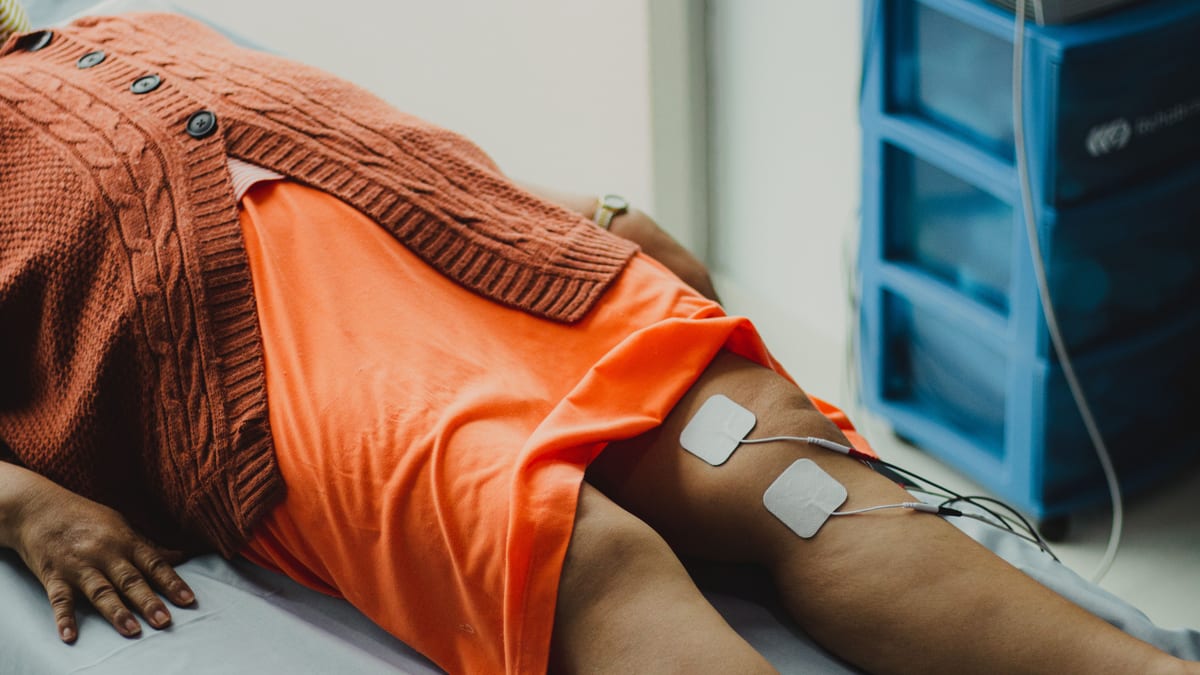
- Deliver the care: mobilisations, massage, active exercises, manual techniques, electrotherapy, respiratory rehabilitation.
- Educate the patient: posture, movements to avoid, exercises to do alone, relapse prevention.
- Coordinate with doctors, surgeons, nurses and other carers around the case.
- Run the practice (in private work: scheduling, coding of procedures, accounting, equipment).
Work settings vary: a town practice, a functional rehabilitation centre, a hospital ward, a sports club, a facility for the elderly or people with disabilities, or the patient’s own home. The pace is demanding, especially in private practice, where the number of patients per day is high. The job is physical and calls for good stamina.
A typical day
Camille, a fictional self-employed physiotherapist based in a private practice, moves through her morning appointments: a patient recovering from knee ligament reconstruction, an elderly person for respiratory physiotherapy, an amateur athlete with a tendon injury. In the afternoon she travels to the home of a patient who cannot leave the house, then finishes with the coding of her procedures and updating patient records. A full, physical day, but paced by concrete, visible progress.
What studies lead to physiotherapy: from the baccalaureate to the diploma
There is no direct entry after the baccalaureate. Training lasts five years in total: a selective first university year, then four years in a physiotherapy training institute, the institut de formation en masso-kinésithérapie (IFMK).
Recommended baccalaureate specialisms: a solid scientific profile is expected. Physics-Chemistry and Life and Earth Sciences (SVT) are the best-suited combinations, possibly rounded out with Mathematics. A strong level in science is decisive for surviving the first-year selection.
The entry paths (the point of confusion): you enrol through Parcoursup in a first university year, then a selection decides who enters an IFMK. Three main doors:
- The PASS (Parcours d’accès spécifique santé, the specific health-access pathway): for balanced scientific profiles hesitating between several health fields.
- The L.AS (Licence avec option accès santé, a bachelor’s degree with a health-access option): for those who want to secure a bachelor’s in a subject they enjoy while aiming for health.
- A STAPS (sport science) or biology bachelor’s: a common route, notably for sporty profiles, where the university has signed an agreement with an IFMK.
The number of IFMK places is capped and shared out by agreement between universities and institutes. In practice, the places coming from STAPS, PASS or L.AS vary from one region to another, so check the precise terms on each Parcoursup listing.
The qualification earned: the State Diploma of Physiotherapy (Diplôme d’État de masseur-kinésithérapeute), mandatory to practise, which has carried master’s grade since the training reform that came into force in 2015.
| Stage | Length | Diploma / step |
|---|---|---|
| First university year (PASS, L.AS, or a STAPS / biology bachelor’s) | 1 year | Pass the year, then IFMK selection |
| Training in an IFMK | 4 years | State Diploma of Physiotherapy (master’s grade) |
| Total | 5 years | Registration with the professional body, practice |
Prospects, employment and pay
The market is buoyant. The density of physiotherapists is rising (154.5 per 100,000 inhabitants on 1 January 2024, Ordre des masseurs-kinésithérapeutes), but demand for care stays very strong and geographic disparities leave many areas under strain. Entry into work is almost immediate: a new graduate finds a job quickly, in private practice as in salaried roles.
Pay depends heavily on the mode of practice.
| Mode of practice | Indicative pay (2024) |
|---|---|
| Hospital employee, early career | around 2,100 EUR gross / month |
| Hospital employee, late career | up to around 3,600 EUR gross / month |
| Self-employed practitioner (average) | around 3,400 EUR net / month, highly variable |
These amounts are orders of magnitude (2024 sources, to cross-check against the hospital public-service pay scale and the professional body’s data). In private practice, real income depends on patient volume, running costs and how the practice is managed.
Specialisms and career moves: sports, respiratory, neurological, paediatric and pelvic-floor physiotherapy, and manual therapy. A physiotherapist can also move into teaching in an IFMK, research, supervision, or opening and running a practice that employs collaborators.
An international perspective
Because this profile describes the French route, a fair question follows: how far does the French diploma travel? The honest answer is that physiotherapy does not enjoy the automatic recognition that a few health professions have, so you should not oversell its portability.
Within the EU and EEA. European law (Directive 2005/36/EC) grants automatic recognition to a short list of health professions only: doctors, general-care nurses, midwives, dentists, pharmacists and veterinary surgeons (plus architects). Physiotherapy is not on that list. It is recognised under the directive’s general system, meaning case by case: the host country’s competent authority reviews your training and can require compensation measures (an aptitude test or an adaptation period) if the content differs. Recognition is common in practice, but it is neither automatic nor guaranteed, and it varies by country. Treat it as a real but conditional door, not an open one.
Outside the EU. Physiotherapy is a nationally regulated profession almost everywhere, so the French diploma does not transpose on its own.
- In the United Kingdom, physiotherapists are regulated by the Health and Care Professions Council (HCPC). An internationally trained applicant applies for registration and has their qualification assessed against UK standards before they can use the protected title.
- In the United States, physical therapy is licensed state by state. Foreign-trained applicants typically go through a credential evaluation, then sit the national licensing exam (the NPTE), and may need to meet additional state requirements.
Other English-speaking countries (Canada, Australia) run their own assessment and examination systems on similar lines. In every case, budget time for a formal equivalence process and, often, a language requirement.
So who is the French route for? It makes clear sense if your family is already in the French or AEFE school system, if you want to practise in France, or if you are comfortable working within France and the EU where recognition, though conditional, is usually workable. If your firm plan is to practise in the UK, North America or Australia, it is worth comparing the French route with training taken directly in the country where you intend to work, to avoid a lengthy recognition process later. The skills of a physiotherapist are universal; the licence to practise is national.
Who the job suits: qualities and interests
The profession suits people who enjoy sustained human contact, can explain and reassure, and accept physically demanding work. The key qualities: a capacity to listen, clinical rigour, patience (rehabilitation takes time), physical stamina, and genuine ease with people.
Honest counter-indications: a difficult relationship with physical contact, a physical fragility (the back and hands are used all day long), or an aversion to long relationships with sometimes discouraged patients make the job hard. You also have to accept how competitive entry is: aiming for physiotherapy without a solid scientific base exposes you to failure in the first year.
If you are hesitating between several caring professions, or between physiotherapy and another health field, structured guidance work helps test the plan against the reality of the selection and the daily job. The career profiles hub and a guidance review help you clarify what you are really looking for before committing to five years of study.
Bridges and changes of direction: getting it wrong is not fatal
Nothing is final. A student who misses IFMK selection after a PASS or an L.AS keeps the credits already earned and can continue in a bachelor’s (biology, STAPS, sciences), try again the following year, or move towards other, related para-medical fields: occupational therapy, psychomotor therapy, osteopathy, nursing, or adapted physical activity.
Conversely, a qualified physiotherapist can use bridges towards other health jobs or move into teaching and research. Neighbouring professions (occupational therapist, osteopath, adapted-physical-activity teacher) share part of the field and are credible alternatives if the physiotherapy route closes.
Key takeaways
- Mandatory qualification: the State Diploma of Physiotherapy (Diplôme d’État de masseur-kinésithérapeute), master’s grade.
- Length: 5 years (1 selective first university year + 4 years in an IFMK).
- Entry path: PASS, L.AS, or a STAPS / biology bachelor’s, then IFMK selection. No direct entry after the baccalaureate.
- Headcount: close to 106,000 registered practitioners on 1 January 2024, of whom around 85 percent in private practice (Ordre, 2024).
- Pay: around 3,400 EUR net / month for a self-employed practitioner; from 2,100 to 3,600 EUR gross in hospital employment (2024).
- Watch point: the competition is decided in the first year, not at the diploma. A solid scientific base is essential.
- International note: the French diploma is recognised case by case in the EU/EEA (no automatic recognition) and requires a formal equivalence process elsewhere.
Going further
- The guide’s career profiles hub
- Nurse career profile: studies and prospects
- Osteopath career profile
- Psychomotor therapist career profile
- Regulated professions and recognition in the EU (European Commission)
- Access routes to physiotherapy studies (ONISEP, in French)
Written by the Axiom Orientation team.
Frequently asked questions
How do you become a physiotherapist in France after the baccalaureate?
What is the exact qualification needed to practise physiotherapy in France?
Is physiotherapy training competitive in France?
How much does a physiotherapist earn in France?
Can you become a physiotherapist through STAPS?
Read more

Career profiles: exploring French careers by field to find your path
Axiom's directory of career profiles: start from the job to build a solid path, with the real French entry route, honest prospects and an international angle.
10 min read
Nurse in France: IFSI training, the State Diploma and careers
The French route to becoming a nurse: the IFSI school, Parcoursup, the State Diploma, careers, pay and specialisations, plus how the qualification travels abroad.
8 min read

Becoming an AI Engineer in France: Studies and Prospects
Becoming an AI engineer in France: bac+5 studies, the scientific foundation required, honest prospects and pay. An Axiom career profile.
11 min read

Architect: the French route from ENSA to the HMONP
The French route to becoming an architect: the real path (ENSA, DEEA, State Diploma, HMONP), the protected title, the Ordre and honest prospects.
9 min read
Photo credits: Juan Manuel Montejano Lopez · Pexels · source