







 France
  English
  United Arab Emirates
  España
  Россия
  中国
中国 French Schools Abroad: Making Sense of the AEFE Network
A French school in your city, but you are not French and the labels mean nothing to you? Here is what homologation, the AEFE and the MLF actually guarantee, and how to choose with confidence.
There is probably a French school in your city. Perhaps several. If your family is not French, you may have walked past the “Lycée Français” without ever quite knowing what it is: a private school? A state school? An international school that happens to teach in French? And what do all those labels mean, AEFE, “homologuée”, Mission laïque française? This guide untangles the network for international families, with no prior knowledge of the French system required.
Let’s say it plainly: even French parents find this confusing. So if the acronyms make your head spin, you are in good company.
Every country has its own specificities, but the logic of the network is the same everywhere. Once you understand a handful of key concepts, homologation, the AEFE, the different partnership levels, you can read any school’s status and know exactly what you are signing up for.
Start here: what “homologation” means
The single most important word in this whole landscape is homologation. A school abroad is “homologuée” when the French Ministry of Education has formally accredited it: the school follows the official French curriculum, meets French teaching standards, and prepares students for French qualifications such as the brevet (end of middle school) and the baccalauréat (the French high school diploma, widely accepted by universities worldwide).
For a family, homologation guarantees two practical things:
- Your child follows the same programme as a student in Paris or Lyon, taught to the same standards.
- Your child can transfer between any homologated school in the world, or into a school in France, without entrance exams or lost years. For internationally mobile families, that continuity is the network’s biggest selling point.
If a school is not homologated, it may still teach partly in French, but none of the above is guaranteed. Checking a school’s accreditation status, always stated on its website and in the AEFE’s official directory, should be your first reflex.
The AEFE: one network, several levels of attachment
Most homologated schools abroad belong to the network coordinated by the AEFE, the French government agency for French education abroad. But not all member schools have the same relationship with the agency, and the differences matter.
Directly managed schools. These are run by the AEFE itself. In practice, it is as close as you can get to a French state school outside France: same curriculum, same diplomas, and many teachers are French civil servants posted abroad. The range of electives and tracks may be narrower than in France (vocational and technical streams are rare), and schools usually add serious teaching of the host country’s language, which is excellent news for your child’s local integration.
Partner schools with an AEFE agreement (“conventionnées”). These are independently governed schools bound to the AEFE by a formal agreement. The agency is involved at a financial, administrative or pedagogical level, and teachers from the French national education system are often seconded to them.
Homologated schools without an AEFE agreement. These schools hold the ministry’s accreditation but are operated by another body, most notably the Mission laïque française (MLF), a long-established French educational association, or by other French or international groups. Here too, some teachers may come from the French national system. The educational guarantee (curriculum, diplomas, transferability) is the same, because it flows from homologation itself, not from the operator.
What it costs
One thing surprises many families: although school is free in France, French schools abroad charge tuition, and the budget can be substantial. Fees vary enormously from one country to another, and a scholarship system exists (eligibility rules apply, so ask the school directly).
There is one striking exception: Germany, where French schools are public and therefore free. The Lycée français de Berlin is the oldest French school abroad, founded in 1685 to educate the children of Huguenots who fled France, and it has kept its status ever since. Germany is also home to a handful of Franco-German lycées that award a specific joint baccalaureate created in 1963 by de Gaulle and Adenauer to seal the reconciliation between the two countries: there are three in Germany (Freiburg, Hamburg, Saarbrücken) and two in France.
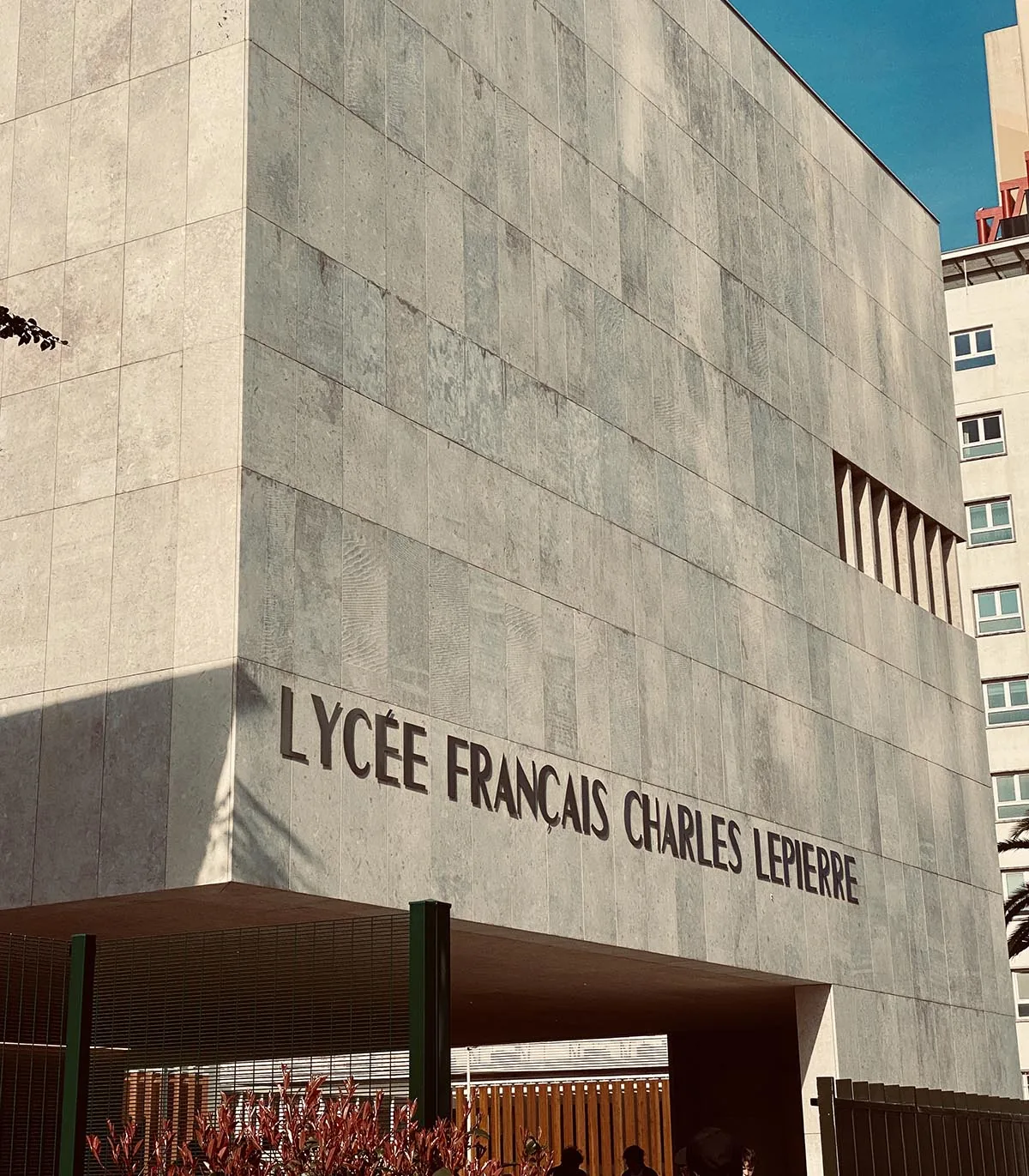
Lycée français Charles Lepierre in Lisbon © Constantin Mardoukhaev
Dual-diploma tracks in Germany, Italy and Spain
If you live in one of these countries and your child can study in the local language, some schools offer binational sections leading to a double diploma: the French baccalauréat plus the equivalent national qualification.
- The Abibac (French-German) is offered by the French lycées of Berlin, Frankfurt, Düsseldorf, Hamburg and Munich, and by 83 German public schools.
- The Esabac (French-Italian) is available at the French lycées of Rome, Milan and Florence, as well as in some Italian public schools.
- The Bachibac (French-Spanish) is offered in many Spanish public schools, and even at the École française de La Havane in Cuba.
For an international family, this is worth pausing on: where these tracks exist in public schools, you can benefit from the host country’s free state system while your child still earns a French diploma. Two university systems open up at once.
Beyond the French label: European and international schools
The French network is only one part of the international schooling landscape in most cities.
In Europe, a number of European Schools are run directly by the European Union. They award the European Baccalaureate, recognised in France and in every EU member state.
And then there are the many international schools belonging to a wide variety of groups, with a wide variety of values and price tags. Most offer the International Baccalaureate (IB), taught in English, French or Spanish and extremely well regarded by universities worldwide; some IB programmes include a career-related stream, and some local public schools even offer the IB as an option. Alumni networks and parent associations are your best source of honest intelligence about any of them.
A worked example: the Netherlands
To see how these categories play out in a real country, here is the Dutch landscape:
- The Lycée français Vincent Van Gogh: directly managed by the AEFE.
- The International French School Amsterdam: homologated by the French Ministry of Education and part of the AEFE network, but operated by the International Education Group, which also runs schools in Morocco and Ethiopia.
- More than 30 international schools, from the British School to the American School, most offering the IB. Each programme deserves a close look.
- The European School of Bergen, managed directly by the European Schools office in Brussels.
Four schools, four different statuses. Once you can read the labels, the choice becomes far less mysterious.
How to choose, in practice
A short checklist for international families:
- Check the accreditation. Is the school homologated? For which year groups? (Some schools are accredited for primary only.)
- Think about mobility. If you may relocate again, the French network’s transferability is a major asset.
- Assess the language question honestly. French schools welcome non-French-speaking children, especially when they are young, but older students may need language support to thrive.
- Look at the exit diploma. French baccalauréat, dual diploma, European Baccalaureate or IB: all are strong, but they open slightly different doors depending on where your child might study later.
- Talk to the community. Parents and alumni will tell you what no brochure will.
One last thing: France has announced its intention to double the number of students in French schools abroad by 2030, so expect the network to keep growing and evolving.
How Axiom Academic can help
Axiom Academic works with families in French schools abroad every day, including many non-French families. Our tutors support children in French as an additional language, keep them on track in the core subjects of the French curriculum, and prepare them for the brevet and the baccalauréat. Our academic advisors can also help you compare the schools in your city and think through the French-versus-IB question for your child’s university plans. Every first lesson is covered by a money-back guarantee, so trying us out is risk-free: get in touch and tell us about your situation.
Key takeaways
- Homologation means official accreditation by the French Ministry of Education: same curriculum, same diplomas, seamless transfers worldwide
- The AEFE network has several levels: directly managed schools, partner schools with an agreement, and homologated schools run by other operators such as the Mission laïque française
- French schools abroad charge tuition, with fees varying widely by country; in Germany they are public and free
- Dual-diploma tracks (Abibac, Esabac, Bachibac) combine the French baccalauréat with the German, Italian or Spanish equivalent
- European Schools and IB world schools are strong alternatives; always check accreditation status and talk to parent and alumni networks before deciding