












 France
  English
  United Arab Emirates
  España
  Россия
  中国
中国 Why Hybrid Tutoring Could Be the Right Academic Support for Your Child
Your child could use a little extra academic support, but you are not sure whether to choose in-person or online tutoring?

Your child could use a little extra academic support, but you are not sure whether to choose in-person or online tutoring?
What if you simply opted for a middle path between in-person and online lessons, known as “hybrid tutoring”?
First, let’s look at how it works.
A hybrid course is, in essence, an alternation between in-person private lessons and online private lessons.
The way lessons are organised is completely free and flexible. It can be a straightforward alternation between in-person sessions and lessons on Zoom or another platform, or it can follow a more elaborate pattern: one in-person lesson per month and three online lessons, for example. More and more tutors also opt for a flipped-classroom approach: students absorb the theoretical content independently, as homework, so that in-person time can focus on the social and methodological side of the tutor-student relationship, or on practical work, for instance in the sciences. This works just as well whether your child is preparing IB exams, GCSEs or the French Bac.
Hybrid tutoring can be set up with a single tutor or with two different tutors.
The advantage is that everything is possible. The drawback is that choosing can feel daunting. Of course, the flexibility these formats offer means you can adjust, fine-tune and improve the arrangement at any time.
Still, here is a detailed description of each option to help you decide.

Photo by Mikhail Nilov
In-person tutoring
An in-person lesson is a “classic” lesson between a tutor and a student who are in the same place: either the student’s home or another room, depending on what is available.
What are the advantages of in-person lessons?
First of all, they foster genuine social contact between two people. During the pandemic, the countless interactions through various platforms, from Zoom to Skype, Messenger and WhatsApp, made many people develop, or become aware of, their need for real “social contact”.
Naturally, this format should be favoured for students with that kind of profile, or for those who already spend too much time in front of a screen.
A private lesson is also, quite simply, a presence, and we know from experience that being present online and being present in the room do not have quite the same impact on social interaction. Face-to-face presence is far more engaging, which makes it the better choice for students who lack motivation, who need a boost, or who benefit from a personalised walk-through of the key points of the lesson.
Depending on the specific needs, whether the priority is the tutor-student relationship or the transmission of content, the tutor may steer the lesson towards a flipped classroom model, delegating the study or revision of theoretical material to independent work through reading and/or watching videos. This does not prevent the student from asking their tutor any questions they wish about that material, of course, but the actual delivery of the content no longer goes through the tutor. It is ideal for moderately independent students who simply need someone alongside them to structure their study, much like a coach would. A student revising GCSE science or working through an IB Internal Assessment, for instance, can prepare the theory at home and use the in-person session to consolidate method and practice.
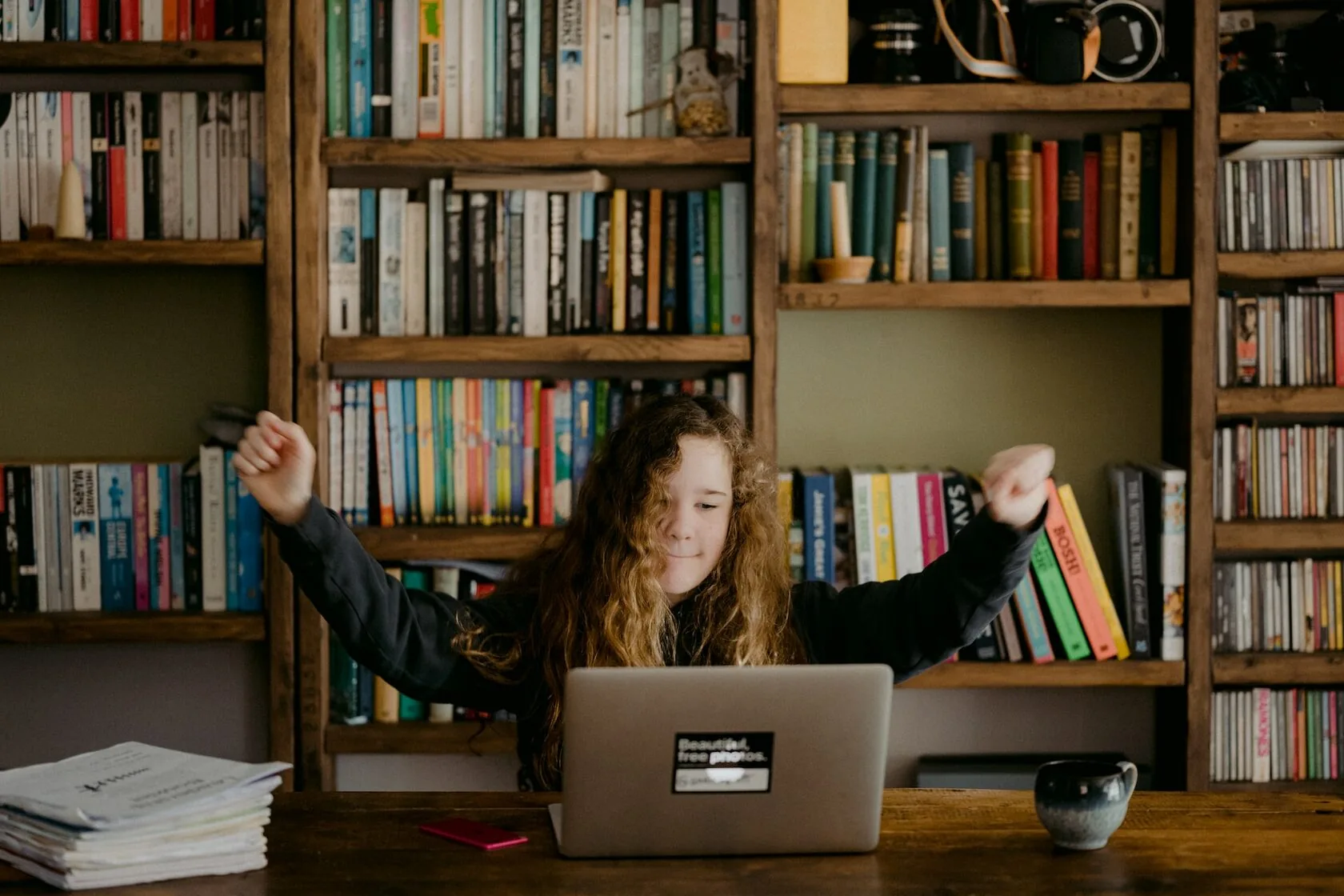
Photo by Annie Spratt on Unsplash
Online tutoring
The advantages of online lessons hardly need introducing: enormous flexibility, savings on travel costs, time gained, and the possibility of connecting tutors and students on opposite sides of the world.
This format makes it possible, without leaving home, to teach and receive a wide range of subjects, a real dream for expat families who want to stay connected to the curriculum of the country they left behind, whether that means the French Bac, the British system leading to GCSEs and A Levels, or the IB.
However, as many have discovered, online lessons sometimes have their limits. Yes, they are very convenient, but if the student is not at least somewhat organised, it can turn into a disaster. Lessons need to be written down, either in a dedicated notebook with precise references for each session, or in a word-processing file carefully filed in the folder for that subject. The notes must then be read, re-read and studied, since they form the foundation for all future progress. They therefore need to be easy to find and use.
Hybrid tutoring
Hybrid tutoring is the ideal way to combine in-person and online lessons while keeping the advantages of each, without the drawbacks.
Does your child struggle with organisation but show real potential for independence that you would like to see develop? Hybrid tutoring fits this profile exactly. Online lessons save time and allow immediate focus on the content, while the fact that the tutor meets the student in person from time to time (say, once a fortnight or once a month) makes it possible to see first-hand how the student organises themselves and works, and therefore to help improve their study habits with methodological advice that lands far better than it would online.
Likewise, if your child lacks confidence and needs a “presence” to give them a boost, alternating online lessons with visits from a tutor-coach to review material, either regularly or before an assessment, for example, is the answer to overloaded schedules and the difficulty of carving out time for lessons.
Another possibility, in a quite different working spirit, would be to have one tutor come to the house for everything related to study skills, methodology and stress management, and another tutor online for subject content.
As you can see, the possibilities abound. It is now up to you to decide which one best suits your child’s profile and circumstances.
How Axiom Academic can help
At Axiom Academic, we support families around the world with private tutoring that adapts to their lives: in person, online or hybrid, with tutors experienced across curricula including the IB, GCSEs and A Levels, and the French Bac. Our advisers help you define the right format and rhythm for your child, and every engagement starts with a first lesson backed by our satisfied-or-refunded guarantee. To discuss your child’s needs, get in touch with us.
Key takeaways
- Hybrid tutoring alternates in-person and online private lessons, with a completely flexible schedule
- In-person lessons offer engagement and social contact, ideal for students who need motivation or structure
- Online lessons bring flexibility and time savings, but require a well-organised student
- The flipped-classroom approach frees lesson time for method, practice and coaching
- Works across curricula: IB, GCSEs and A Levels, French Bac
- You can combine one tutor for both formats, or two tutors with complementary roles